01 — UGLY DUCKLINGS
Turning ugly ducklings into swans for a living.
Noble materials don't lose their nobility when they're discarded. Sometimes they're simply too irregular, too small, too imperfect or too difficult to fit into the logic of mass production.
But what makes a material unsuitable for one purpose can make it extraordinary for another. A flaw can become a feature. An irregularity can become a signature. What the industry sees as a limitation, Iñigo sees as a source of individuality.

Old timber beams reclaimed from century old buildings
02 — unrealized potential
Some things deserve a second look.
For Iñigo, the search for materials is an open-ended exploration. There is no fixed catalogue, no predetermined list of ingredients.
Each discovery opens the door to another, bringing materials with different histories and origins into the same creative universe. The search is ongoing, and the possibilities keep growing.
The collection ranges from oak beams salvaged from Cádiz's former British Embassy, dating back to 1750, to naturally fallen and seasoned trunks, monumental timber slabs and narcotráfico teak logs seized by customs and recovered through public auctions.
It includes the less obvious remnants of woodworking: rotten beam ends, wood shavings and sawdust, used in laminated or encapsulated forms. There are marble fragments rescued from stonemasons' rubble skips, 18th-century clay bricks, oyster shells sourced from a three-Michelin-starred restaurant and shells from other molluscs. Traditional Cádiz bluefin tuna fishing nets sit alongside textile remnants from haute couture ateliers, steel scale and dust from industrial forging, broken glass and sand recovered from historic buildings.
The inventory is never complete. New materials continue to emerge from unexpected places, each carrying traces of its former life and the possibility of a new one.

18th-century clay bricks, crushed to be reshaped and combined
03 — CRAFT, REIMAGINED
Traditional know-how. Contemporary superpowers.
Iñigo's approach to craftsmanship combines the knowledge and ingenuity of traditional craft with contemporary tools, materials and fabrication techniques.
He sees it as a form of avant-garde craftsmanship: not an exercise in preserving established methods unchanged, but an opportunity to reinterpret them and expand what they can achieve.
The aim is to push craftsmanship into new territory, developing ways of working that allow unconventional materials to become something they couldn't have been before.
Tradition provides the knowledge; contemporary practice opens up new possibilities.

avantgarde cratfs - tradition meets today
04 — FROM IMAGINATION TO MATTER
Every piece begins somewhere in Iñigo's mind: an image, a shape, a drawing on paper.
But imagining something and bringing it into existence are two very different things.
The challenge lies in bridging that gap.
Understanding a material well enough to know what it can do, experimenting to discover what else it might do, and developing the techniques to turn an idea into a physical object
There's a particular satisfaction in making something that didn't exist before — not just because it looks the way he imagined, but because he's figured out how to make it real.

what if you could build what you sketch
VISUAL INVENTORY
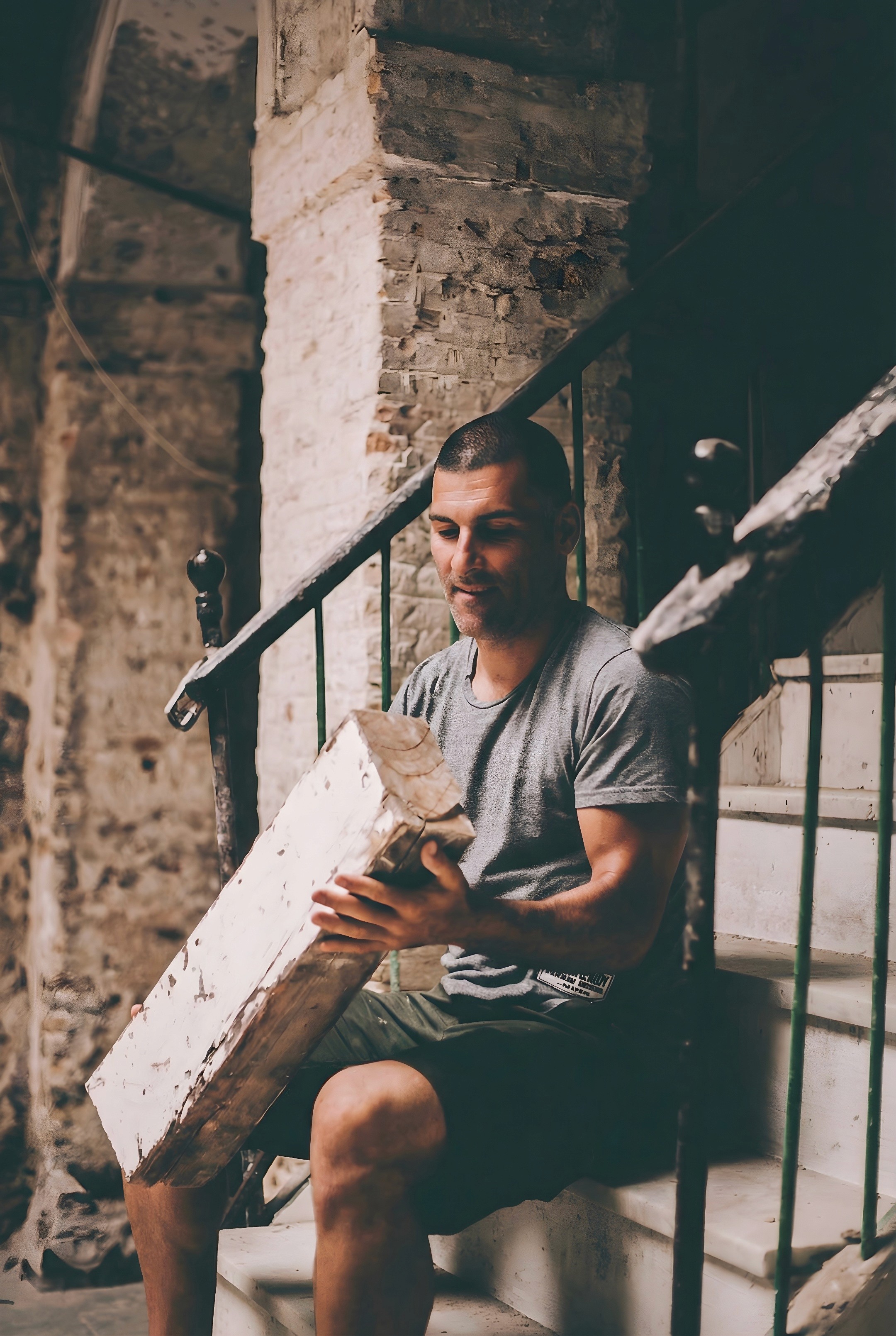
Amber founder Iñigo Calleja, internationally seasoned engineer that started making things with reclaimed wood and it soon became his life project